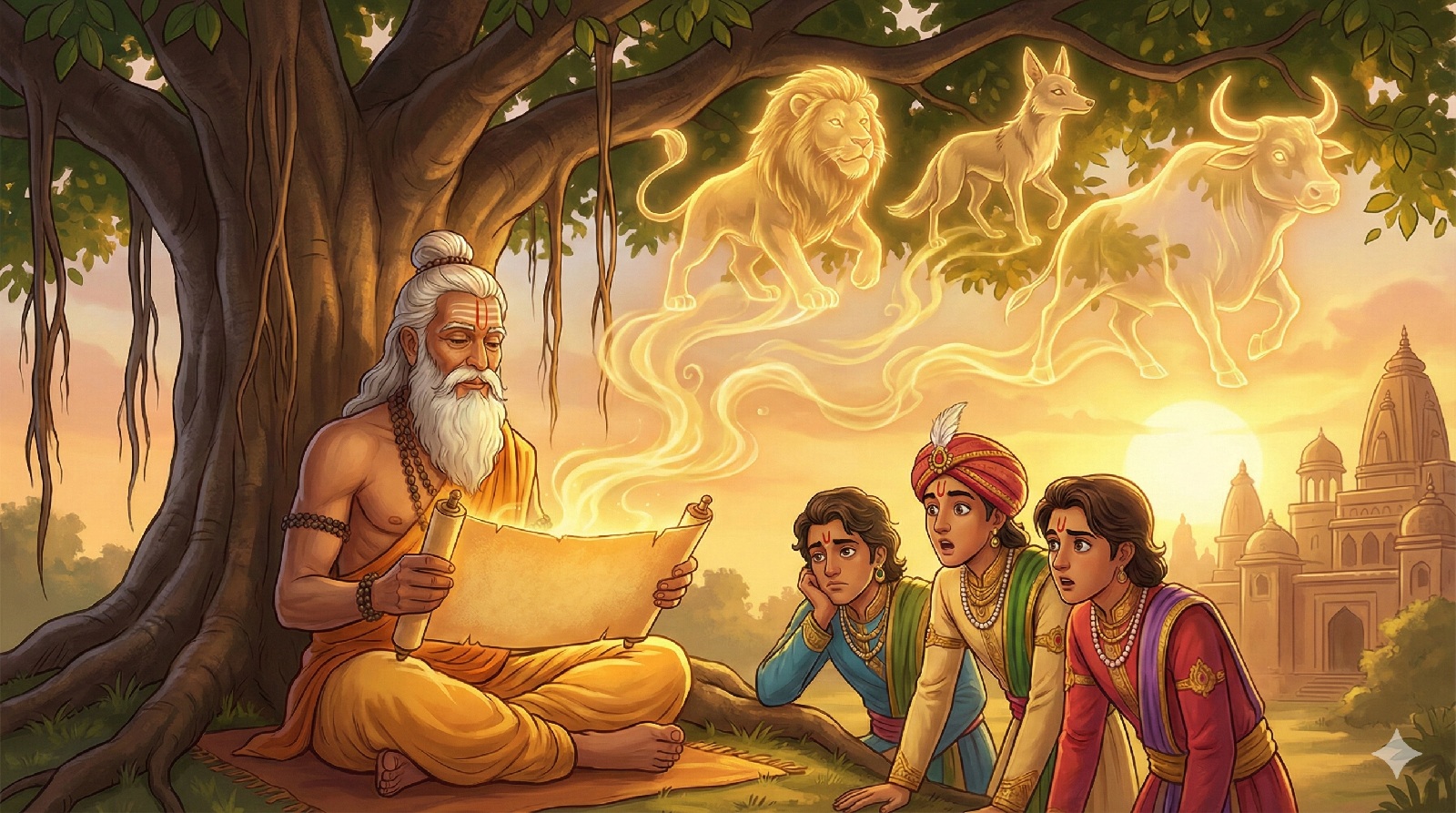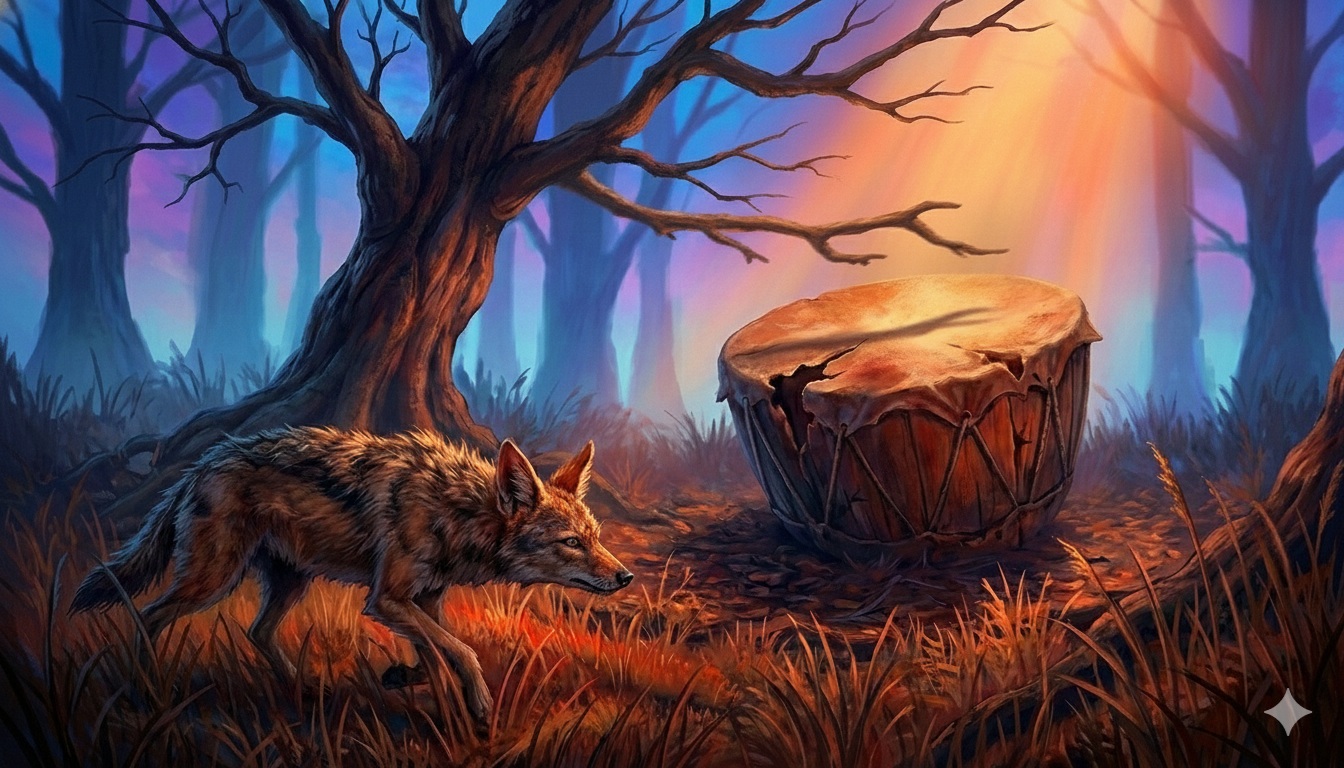
We all have that one friend — “ride or die.” The one you trust with your secrets, and your life. Now, imagine a third person comes along—a manipulator, a whisperer—and suddenly, that friendship turns into a war zone.
That is the essence of The Loss of Friends. It’s the longest and most important book in the Panchatantra because, let’s face it, breaking up is hard to do, but getting played by a “friend” is even worse.
The story starts in the South, in a city called Mahilaropya (yep, “Maidens’ Delight” again). It was the kind of city that would make Dubai look like a village—skyscrapers, tech, and mountains of cash.
In this city lived a merchant named Vardhamanaka (let’s call him Vardha). He was loaded. But Vardha had a specific mindset that every billionaire has: Money that isn’t growing is dying.
He knew the rules of the hustle:
- Release It: Money is like water in a tank; if you don’t let some flow, it stagnates.
- Risk It: You can’t catch a wild elephant with bare hands; you need a tame one. You need money to make money.
- Use It: If you have cash and don’t use it, you’re just a glorified security guard for your heirs.
So, Vardha packed his bags, loaded his cart, and headed for Mathura to close some deals. Leading his caravan were two magnificent bulls: Nandaka (Joyful) and Sanjivaka (Lively).
The Accident
They were crossing a dense forest—scenic but dangerous. Think tigers, bears, and slippery waterfalls.
Suddenly, Sanjivaka (the bull) stepped into a mud patch near a cascade. Snap. The yoke broke, and Sanjivaka collapsed, his leg twisted.
Vardha was devastated. He halted the entire caravan for five nights, praying for his bull to heal. But business is business. The market in Mathura wouldn’t wait. With a heavy heart, Vardha left some caretakers behind with fodder and said, “If he heals, bring him. If he dies… perform the last rites.”
Then, he left.
Now, here’s where human nature kicks in. The caretakers looked at the dark, scary forest. They looked at the sick bull. They said, “Nope.” They abandoned Sanjivaka, ran after the caravan, and lied to Vardha: “Boss, he died. We cremated him. RIP.”
Vardha grieved for a moment, but then moved on.
The Comeback
But Sanjivaka didn’t die. Fate had other plans. The cool mist from the waterfall soothed his leg. He grazed on fresh emerald grass. Alone in the wild, he didn’t just survive; he thrived. He bulked up. He grew a hump like a mountain. He started tearing up ant-hills with his horns just for fun.
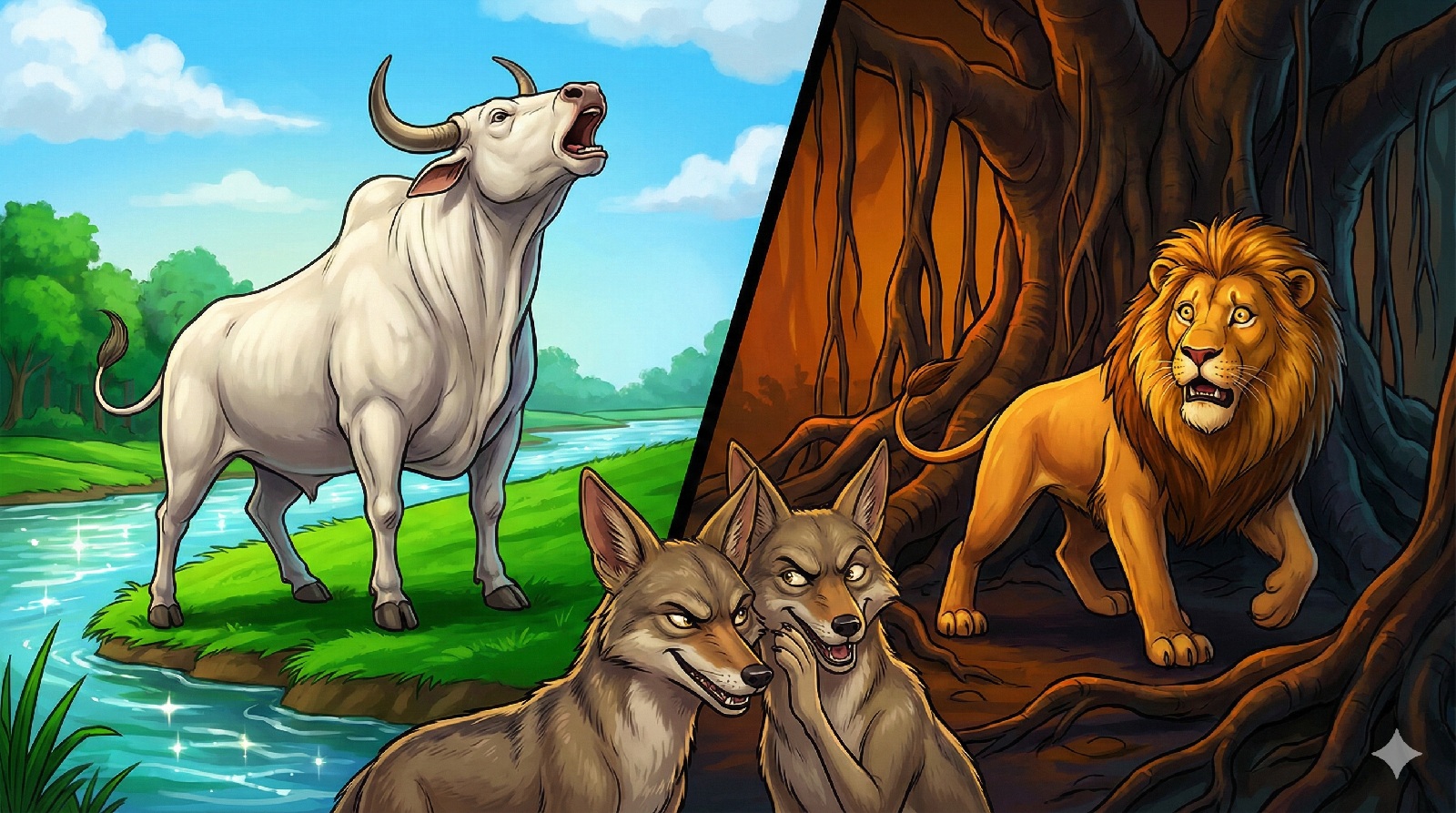
One day, feeling like the King of the World, Sanjivaka let out a bellow. “MOOOOOOOOO!” It wasn’t a normal moo. It was a thunderclap that shook the forest.
The Paranoia of Power
Nearby, drinking at the river, was the actual King of the Forest: a lion named Pingalaka (let’s call him Rusty).
Rusty was a classic alpha. He didn’t do “meetings.” He didn’t have a budget. He just had raw power and a massive ego. But when he heard that ungodly sound—a sound he had never heard before—he froze.
What beast makes a noise like that? Rusty thought. Is it a monster? Is it bigger than me?
Terrified but refusing to show it, Rusty retreated to his panic room (under a Banyan tree) and formed his “Circle of Four”—his inner defence council. He sat there, silent, brooding, and secretly shaking in his paws.
Enter the Manipulators
Watching from the sidelines were two jackals: Karataka (Cheek) and Damanaka (Victor).
These two were the sons of former ministers, but they were currently unemployed and bored. They saw the Lion King hiding under the tree, looking anxious.
Damanaka (the ambitious one) nudged his friend. “Hey Cheek, look at the Boss. He’s thirsty, but he’s hiding. Something’s wrong. This is our chance to get back in the game.”
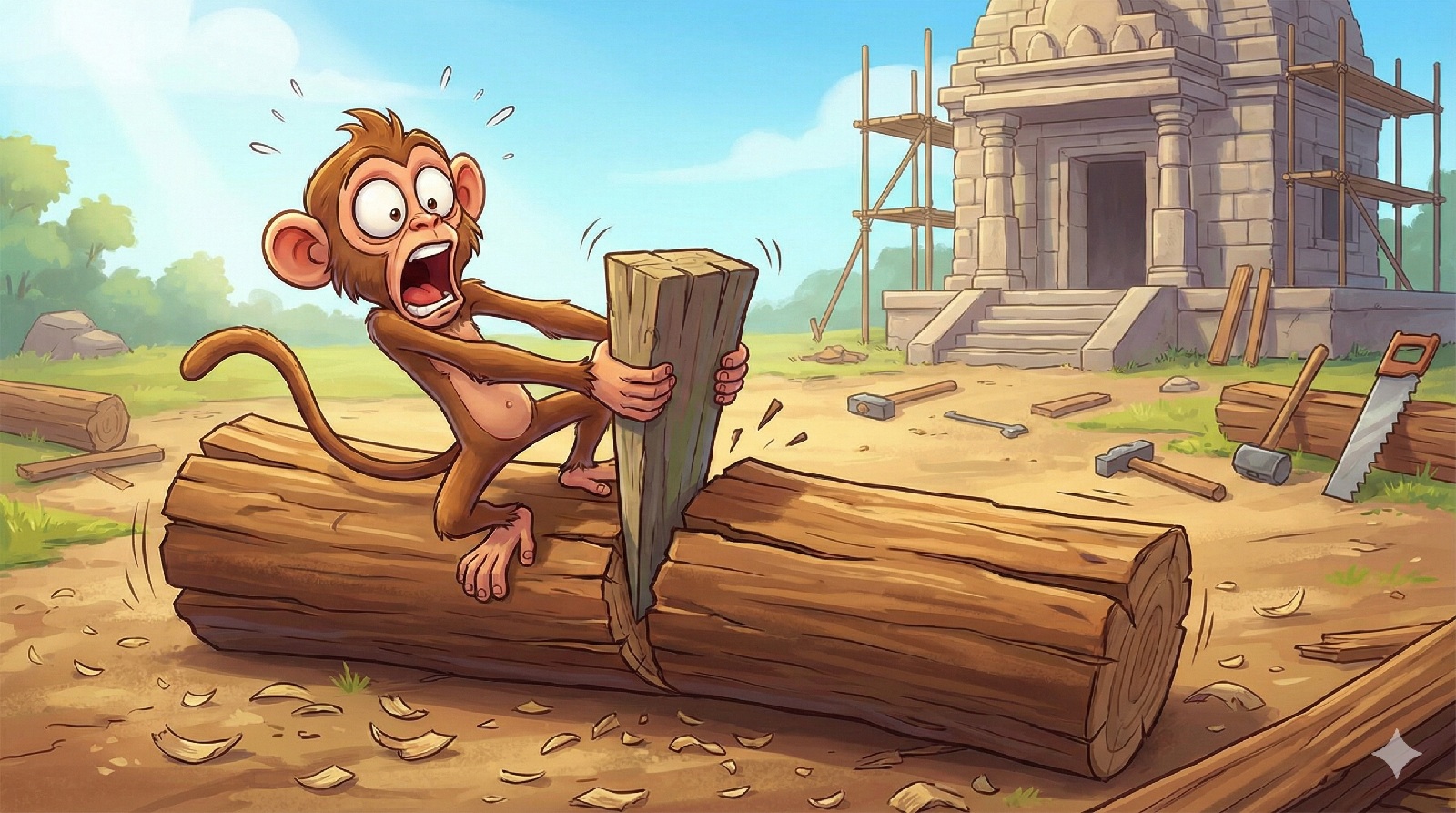
Karataka (the conservative one) sighed. “Bro, chill. We are nobodies. Why meddle? You know what happens to people who stick their nose where it doesn’t belong? Remember the monkey and the wedge?”
“No,” said Damanaka. “Tell me.”
And thus, the game of manipulation began.
💡 The Vacuum of Power
When a leader (Rusty the Lion) shows fear or indecision, it creates a vacuum. And nature abhors a vacuum. That empty space is exactly where manipulators (the Jackals) step in. If you are a leader, never let your team see you sweat over a mystery you haven't investigated yet.
💭 Afterthought
This setup is a masterclass in “Mental Engineering.” Notice how the conflict starts? It’s not because the Lion and the Bull hate each other. They haven’t even met! The conflict starts because of Assumption and Fear. The Lion assumes the noise is a monster. The Jackal assumes he can exploit the Lion’s fear. Most “friendship breakups” don’t happen because of what is true; they happen because of what we imagine is true. We hear a noise (a rumour, a text, a misunderstood silence), we get scared, and then we let the “jackals” in our lives spin the narrative.
🌿 The Vocabulary Jungle
- Diadem: A jewelled crown or headband worn as a symbol of sovereignty. (Used to describe the city’s greatness).
- Stagnation: The state of not flowing or moving; lack of activity or growth (Vardha’s fear about money).
- Alpha: The dominant individual in a group; the leader of the pack (Rusty the Lion).
- Subterfuge: Deceit used in order to achieve one’s goal.
- Interloper: A person who becomes involved in a place or situation where they are not wanted or are considered not to belong (The Jackals).