
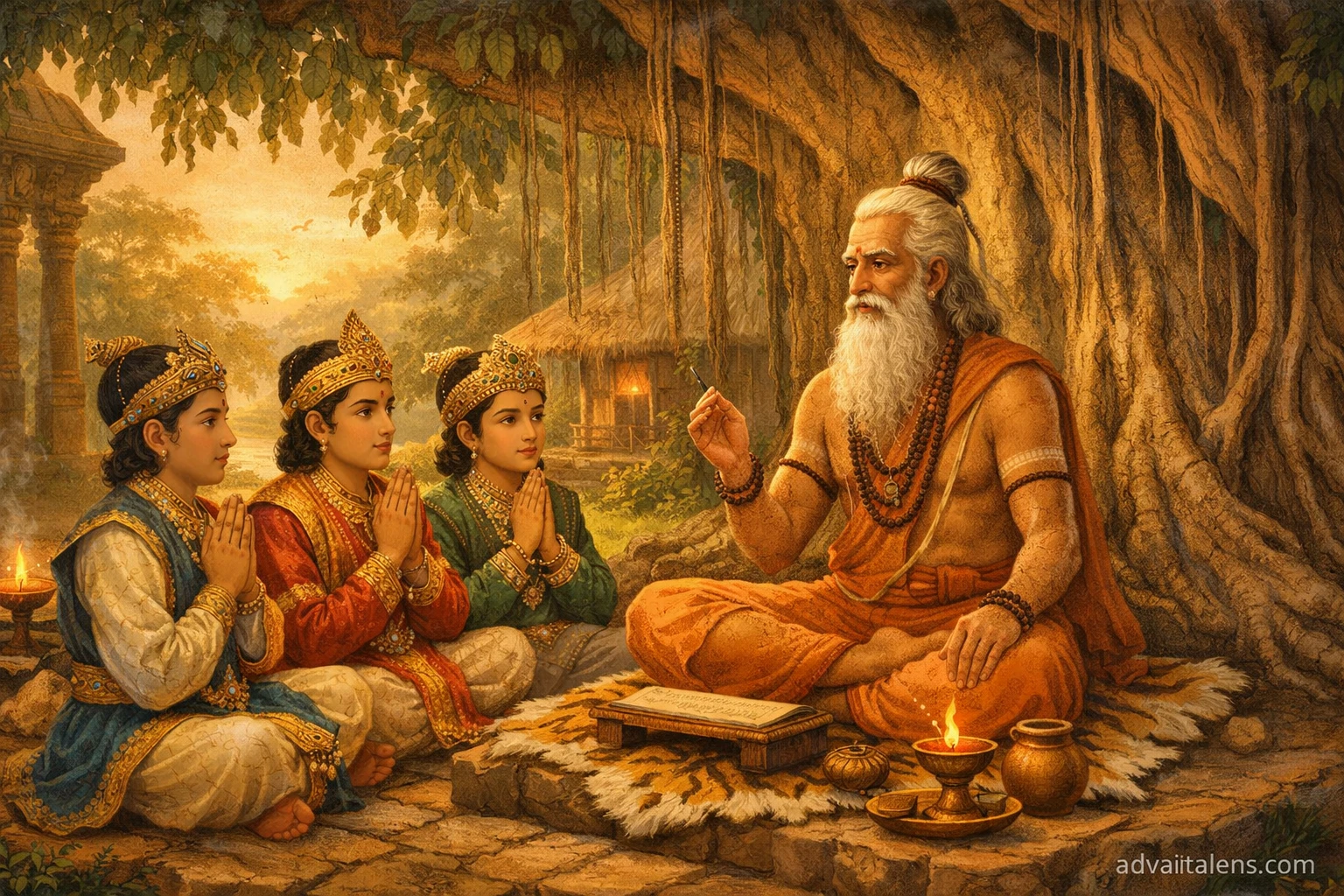
In the southern country, there was a city named Mahilaropyam [a city of great beauty and prosperity]. Its ruler was a King named Amarashakti [endowed with immortal power]. He was a wish-fulfilling tree to the needy, a jewel among kings, and a master of all arts. However, despite his own greatness, the King was troubled by a profound sorrow. He had three sons—Vasushakti, Ugrashakti, and Anekashakti—who were completely devoid of Viveka [discernment] and were Shastravimukha [averse to the study of sacred scriptures].
Observing his sons’ persistent ignorance, the King summoned his ministers and spoke: “O counselors, it is well known to you that these three princes are utterly lacking in wisdom. A kingdom without a wise heir is like a house without a lamp. As the proverb says: ‘Better no son at all, or a son who dies early, than a son who remains a fool; for the first two cause grief but once, while the fool consumes his parents with sorrow throughout his life.’ Therefore, find a way to ignite their intelligence, lest this royal lineage fall into ruin.”
Among the ministers, one named Sumati [of good intellect] addressed the King: “Maharaj [Great King], the study of Shastras [sacred sciences] is a long and arduous path. A man spends twelve years mastering Vyakarana [grammar] alone. After that, he must labor through the works of Manu and others on Dharma [righteousness], Artha [worldly prosperity], and Kama [desire]. Life is short, and the obstacles are many. We must find a swifter method to impart the essence of wisdom. There is a Brahmin [a member of the priestly and scholarly class] named Vishnu Sharman, a master of all Niti-shastra [the science of political and worldly conduct], who is famous among the assembly of scholars. Entrust the princes to him.”
The King summoned Vishnu Sharman and said: “O Bhagavan [Holy One], show me your grace by making these boys experts in the ways of the world. In return, I shall grant you a hundred land grants.”
Vishnu Sharman replied with dignity: “Maharaj, I do not sell Vidya [knowledge] for wealth. However, listen to my lion-like roar: If I do not make your sons masters of Niti-shastra within six months, may I be denied my path to Swarga [heaven]. I seek no gold; I seek only to fulfill this challenge for the sake of the truth.”
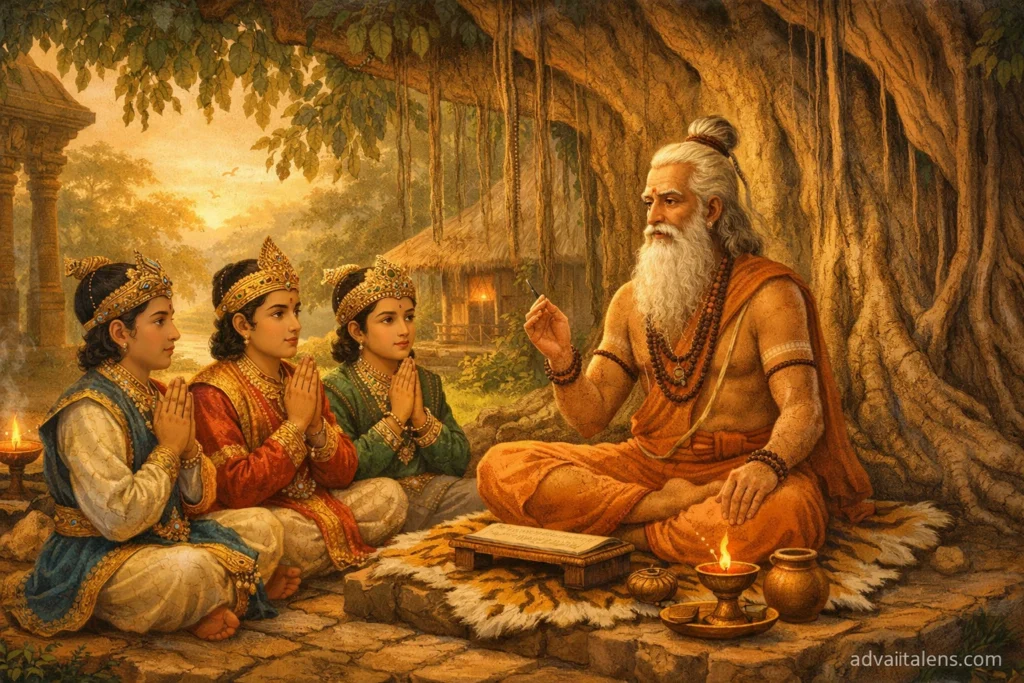
The King, filled with wonder and relief, entrusted his sons to the Brahmin. Vishnu Sharman then composed five books—the Panchatantra [Five Treatises]—to educate the princes through stories. These five books are:
- Mitra-bheda [The Dissension of Friends]
- Mitra-samprapti [The Winning of Friends]
- Kakolukiyam [The War of Crows and Owls]
- Labdha-pranasham [The Loss of Gains]
- Apariksita-karakam [Ill-considered Action]
Having listened to these stories, the princes became masters of statecraft and wisdom within the promised six months. Ever since, this work has served as a guide for the enlightenment of the young and the wisdom of the world.
The Panchatantra highlights the Vedic principle that Vidya (knowledge) is the highest wealth. It establishes that mere biological lineage is insufficient for a ruler; one must possess Atma-jnana [self-knowledge] and Niti [strategic conduct] to protect the Dharma of the land. Vishnu Sharman's vow reflects the traditional role of the Guru [teacher] as one who takes a solemn Sankalpa [divine resolve] to transform the consciousness of the student, regardless of the difficulty. The text teaches that while traditional academic study is vast, the "essence" of wisdom can be distilled through the medium of narrative, making it accessible to those who might otherwise struggle with complex abstractions.