Let’s talk about the loudest sound in your universe. It isn’t a thunderclap, a jet engine, or a rock concert. It’s the tiny, sharp ding of a smartphone screen lighting up in a dark room.
We live in an age of noise. Everywhere you look, someone or something is banging a drum, demanding your attention, your panic, or your validation. But here is the secret of the “Human Machine”: the loudest things in the jungle are usually the most hollow. The roar of a lion means he has power; the banging of an empty wooden drum just means it’s windy.
If you don’t know the difference, you will spend your entire life running from shadows or chasing empty promises. Let’s step into the lab and deconstruct the noise.
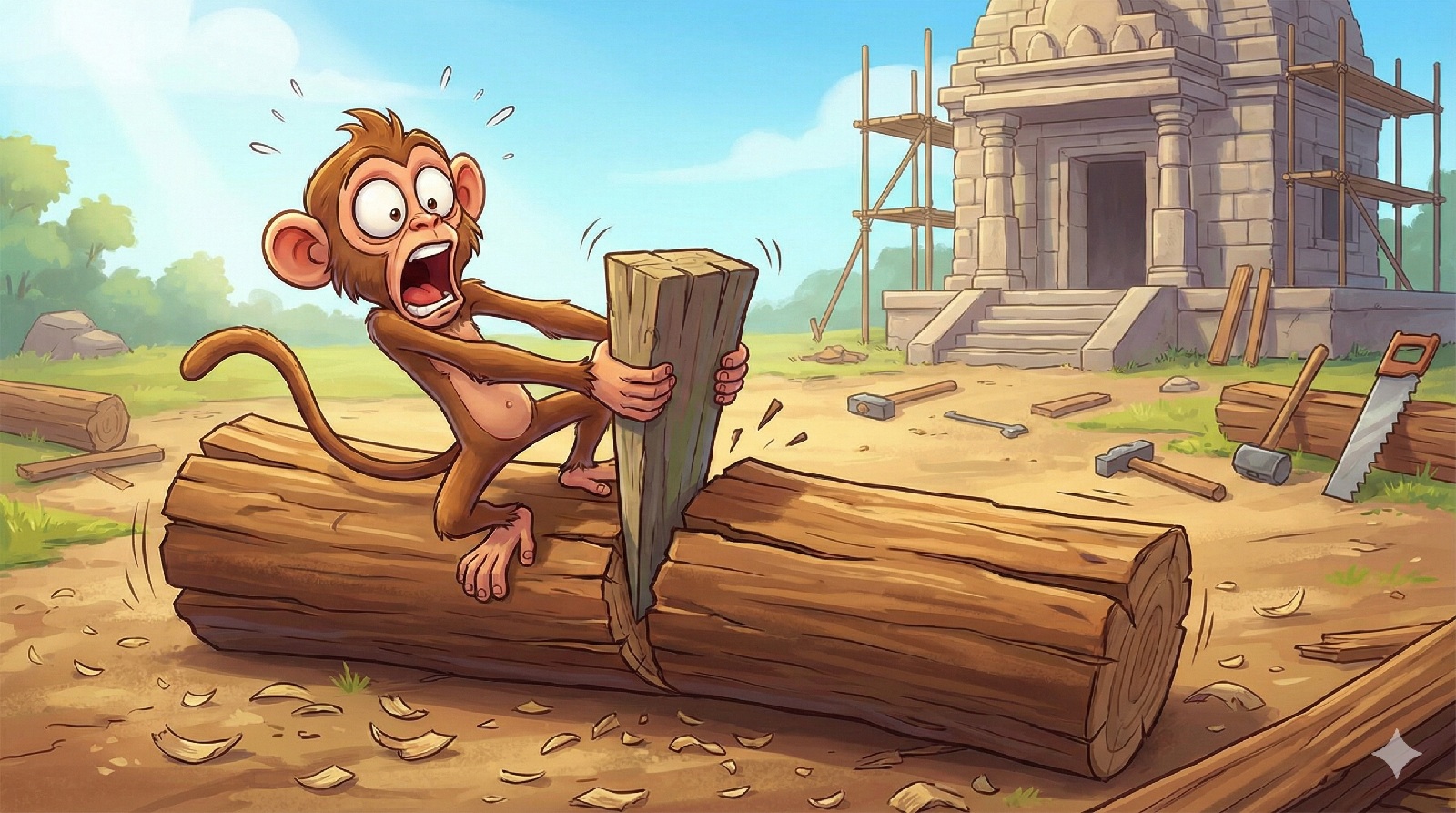
This story is an adaptation of the ancient Panchatantra tale “The Jackal and the War-Drum”.
A Depleted Battery
Meet Kabir. He’s a Class 10 student, and right now, his internal battery is flashing red. It’s 11:00 PM on a Tuesday. He’s tired, he’s stressed about the upcoming Physics practicals, and his “Mental Malware” (anxiety) is already running in the background. He’s just a tired kid looking for peace of mind.
The Trigger: The Digital Boom
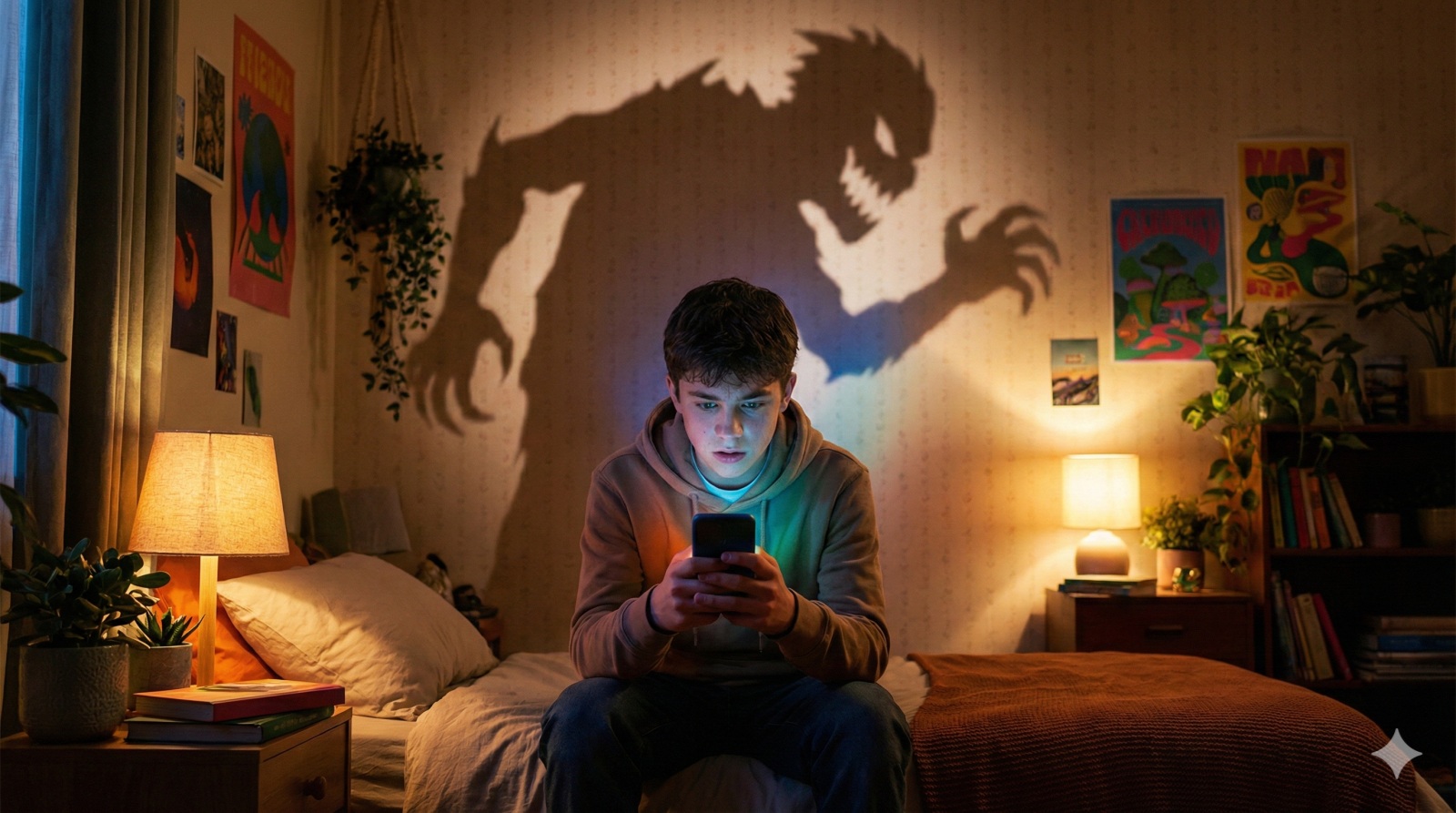
Kabir puts his books away and is about to sleep when his phone lights up. It’s a message from his project partner, Aisha. It doesn’t say “Hey,” or “Are you awake?” It is a single, isolated line of text:
“WE NEED TO TALK. TOMORROW.”
BOOM. No context. No emoji. Just a digital shockwave.
The Glitch: The Catastrophe Cycle
Kabir’s “Human Machine” instantly crashes. The pre-frontal cortex (the logical brain) shuts down, and the amygdala (the survival alarm) takes over.
“I’m dead,” Kabir’s internal monologue spirals. “She found out I messed up the bibliography on the project. She’s going to tell the teacher. I’m going to fail. Everyone in the group is probably talking about me right now.”
Kabir is doing what we all do when faced with ambiguity: he is filling the blank space with his deepest insecurities. He hasn’t even seen the “monster” yet, but his mind has already painted a terrifying picture.
The Pivot: Engaging the Override Code
Kabir’s first instinct is to flee. He wants to turn off his Wi-Fi, throw the phone under his pillow, and avoid Aisha in the hallway tomorrow. His second instinct is to fight—to send a defensive, angry paragraph justifying his work.
But this is where the mental engineering kicks in. Kabir stops. He takes a breath to centre his “Heart-Space.” Logic check: “Why am I running? I haven’t even seen the actual problem. What if I am running away from the wind?”
Instead of letting the ego dictate his reaction, he chooses conscious action. He types back: “Everything okay? What’s up?”
The Reality Check: An Empty Vessel
Three dots appear. Aisha is typing. “My laptop crashed, and I lost my half of the presentation. I’m freaking out. Can you help me recover the file tomorrow?”
Kabir stares at the screen. The terrifying monster—the “WE NEED TO TALK” that almost ruined his sleep and his confidence—was just a panicked friend asking for help. It wasn’t an attack; it was an SOS.
He had spent twenty minutes terrified of an empty drum being beaten by the wind of Aisha’s own anxiety.
💡 The Projection Trap
The Trap: We assume that Volume equals Threat. When we hear a loud rumor, receive an all-caps text, or see a teacher yelling, our ego assumes there is massive substance behind the noise.
The Truth: We project our internal state onto external events. When you are insecure, an ambiguous text becomes a personal attack. You are literally fighting a ghost created by your own mind.
Stop running from the noise. You must walk up to the “War-Drum” and tap it. Investigate the facts before you react to the sound. Nine times out of ten, you will find that the loudest, scariest things are completely hollow inside.
💭 Afterthought
Let’s ground this, my friend. How many times have you ruined your own weekend because of a vague comment someone made on a Friday afternoon? How many opportunities have you run away from because they “sounded” too scary, too difficult, or too loud?
- The school hallway is full of War-Drums. The school bully is a drum—loud, intimidating, but usually empty of any real confidence.
- Social media drama is a drum—a massive cacophony of opinions with zero actual substance.
Real power is quiet. Real intelligence is calm.
When you hear the “BOOM” of drama or panic, do not let your system crash. Anchor yourself. Ask questions. Look inside the drum. You’ll save yourself a lot of unnecessary running.
🪞 The Mirror Test
(Ask yourself this honestly)
- “When was the last time I let my imagination turn a simple message into a worst-case scenario?”
- “Am I reacting to the actual situation in front of me, or to the ‘monster’ my anxiety just created?”
- “Do I give ‘loud’ people or dramatic situations more power over my emotions than they actually deserve?”
- “What is one ’empty drum’ I am currently stressing over that I just need to investigate and clear up today?”
🌿 The Vocabulary Jungle
- Ambiguity: Uncertainty or inexactness of meaning. (The breeding ground for anxiety).
- Catastrophizing: A cognitive bias where you assume the absolute worst will happen, even with zero evidence.
- Projection: A psychological defence mechanism where you place your own internal insecurities onto another person or situation.
- Cacophony: A harsh, discordant, and meaningless mixture of sounds.
- Equanimity: Maintaining a calm state of mind and evenness of temper, especially under stress.