The Itch
Do you recall that itch? You walk past a problem that isn’t yours—a friend’s argument, a messy cable setup, a weird line of code—and your brain screams, “I can fix that.”
It feels like heroism. It feels like you are the smartest person in the room, spotting a mistake that everyone else missed. But in the world of Systems Engineering (and life), there is a massive difference between Observation and Understanding.
If you touch a system you didn’t build, you aren’t an “Optimizer.” You are a liability.
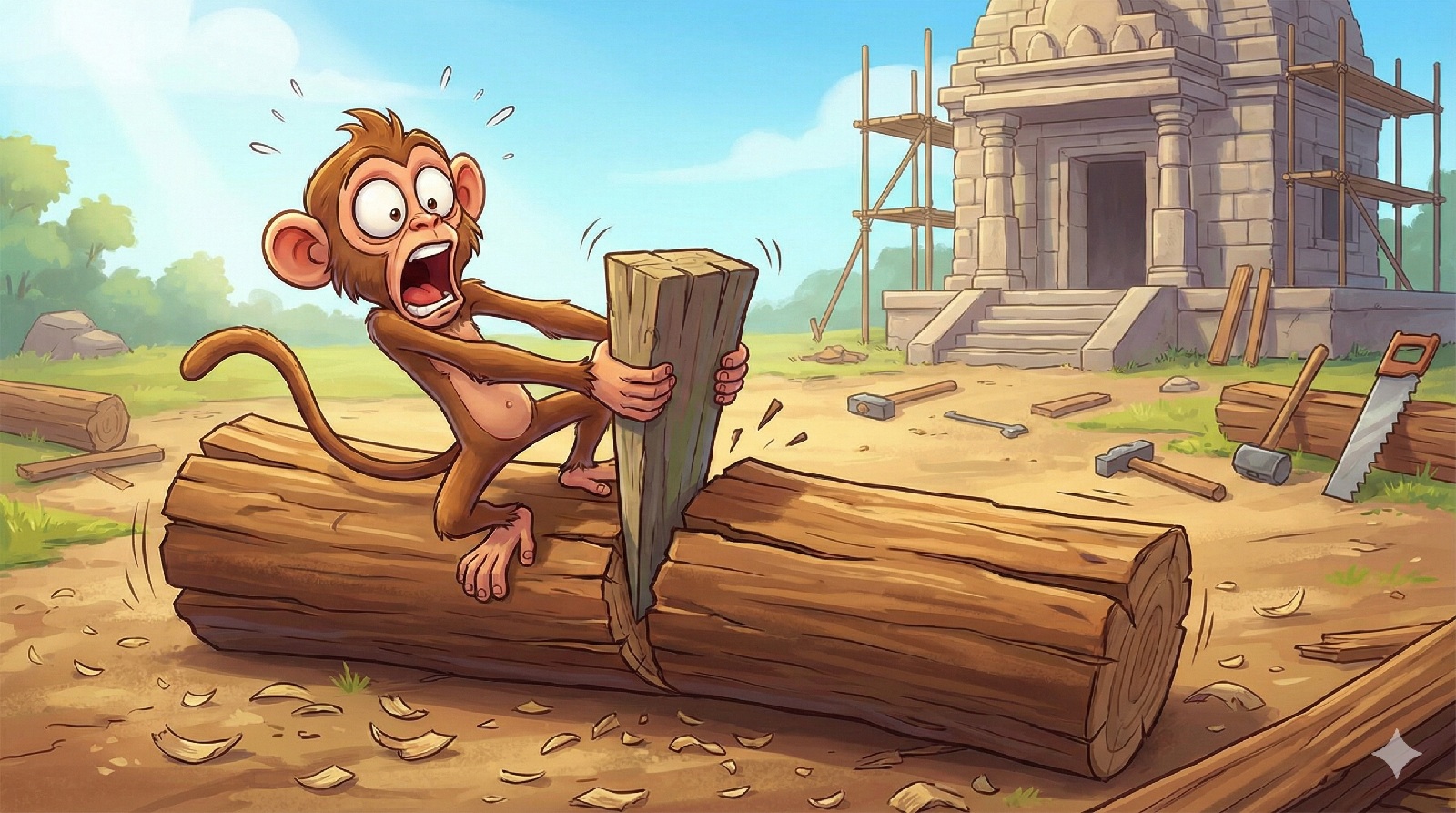
This story is an adaptation of the ancient Panchatantra tale “The Wedge-Pulling Monkey”.
Let’s step into the server room.
A Delicate Ecosystem
The “War Room” (Computer Lab 3) was freezing cold. It was 11:45 AM, fifteen minutes before the launch of the All-School E-Voting Portal. The Class 12 Computer Science team—the “Wizards”—had been coding for 48 hours straight. They had left the system running in a delicate “Debug Mode” while they went to the canteen to munch.
The code was split open, half-finished, and vulnerable. Holding it together was a single, ugly-looking script named do_not_delete_temp_fix.js. It was a patch, a clumsy bridge keeping the database from crashing under the weight of the user interface. It wasn’t pretty, but it was load-bearing.
Enter the “Hero”
Enter Arnav, a bright Class 9 student. He knew Python, he knew JavaScript, and he had just finished an Udemy course on “Clean Code.” He wasn’t on the team, but he had permission to be in the lab to print a poster.
He walked past the main server monitor. He saw the code scrolling. “Ugh,” Arnav’s internal monologue scoffed. “Look at that redundancy. They have a while loop pausing the execution for 200 milliseconds? That’s lag. That’s sloppy.”
Arrogance as Optimization
His ego whispered, “If you optimize this, the seniors will treat you like a god. You’ll be the legend who sped up the election.”
He didn’t know the 200ms pause was there to let the old, dusty school router catch up with the data packets. He didn’t know the “ugly” code was the only thing preventing a deadlock. He only saw a “fence” that blocked his view of perfection.
He assumed that because he couldn’t see the purpose, there wasn’t one.
Removing the Chesterton Fence
Arnav sat in the admin chair. “I’ll just… remove… the bottleneck,” he muttered.
He highlighted the ugly script. He hit DELETE. He hit SAVE.
Blue Screen of Death
Instantly, the cooling fans in the server rack screamed like jet engines. The screen turned a violent shade of “Blue Screen of Death.”
Why? Because without that 200ms “Wedge,” the database tried to process 5,000 student accounts in zero seconds. The processor overheated. The hard drive corrupted. The system crashed.
Arnav sat there, his hand hovering over the keyboard, as the smell of burnt silicon filled the air.
You Didn’t Fix It, You Broke It
The door burst open. The seniors rushed in, holding their sandwiches. They saw the blue screen. They saw the smoke. They saw Arnav. The Lead Developer, a tired guy named Sam, didn’t scream. He just walked over, checked the logs, and saw the deletion timestamp.
“You pulled the wait-command,” Sam said, his voice scary-quiet. “It… it was causing lag,” Arnav stammered. “I was fixing it.” “You didn’t fix the lag, kid,” Sam sighed, pulling the power plug. “You just removed the brakes from a moving train.”
Arnav wasn’t the hero. He was the guy who cancelled the election.
💡 Chesterton’s Fence
The Trap: Second-Order Ignorance. You see a rule, a tradition, or a piece of code that looks stupid. You think, “I don’t see the use of this, so let’s clear it away.”
- The Truth: Reforms should not be made until the reasoning behind the existing state is understood.
- The Mental Malware: “If I don’t understand it, it must be useless.”
- The Principle — Chesterton’s Fence. The reforms should not be made until the reasoning behind the existing state of affairs is understood. That is, do not remove any code until you know why it was put there in the first place. The code might look ugly, but it’s keeping the system working.

💭 Afterthought
Look, I get it. We live in an “Optimization Culture.” We want to hack everything—hack our sleep, hack our grades, hack our friends’ problems. But here is the hard truth: You are not qualified to fix everything you see.
In Sanskrit, this concept is called Adhikara (Qualification/Authority). It means you shouldn’t intervene in a crisis unless you have the competence to handle the fallout. Arnav’s mistake wasn’t that he wanted to help. It’s that he valued his need to feel smart over the safety of the system.
Next time you see — a weird rule at home, a friend’s silence, or a confusing chapter in a book—don’t just yank it out. Ask: “What is this holding up?” Be a Builder, not just a Meddler.
🪞 The Mirror Test
(Ask yourself this honestly)
- Do I actually have the ‘Admin Rights’ (real experience) to solve this problem, or am I just a Guest User with a loud opinion?
- Before I offered my solution, did I ask why they were doing it that way, or did I just assume they were wrong?
- Did I jump into this mess to actually help them, or did I just want the dopamine hit of being the ‘Smart Saviour’?
🌿 The Vocabulary Jungle
- Unsolicited: Not asked for; given voluntarily but often intrusively.
- Chesterton’s Fence: The principle that reforms should not be made until the reasoning behind the existing state of affairs is understood.
- Adhikara (Sanskrit): The authority or qualification required to perform a specific action.
- Latency: The delay before a transfer of data begins following an instruction.
- Second-Order Thinking: Thinking about the consequences of the consequences (e.g., “If I remove this, what happens next?”).