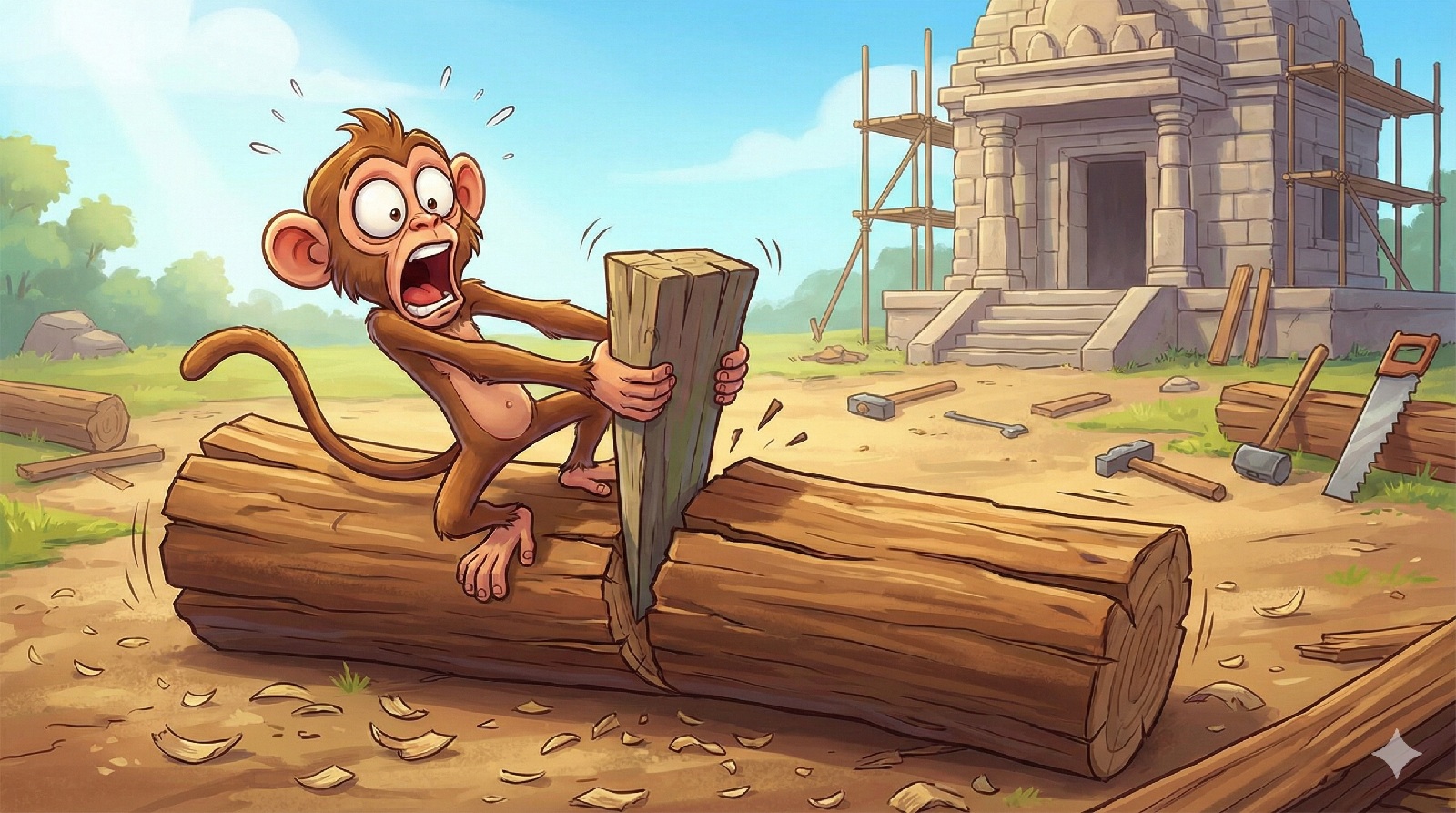
Real Jungle
Hey there, Future Architect!
Let’s be real for a second. Put down the textbooks, pause the Spotify playlist, and look at the screen.
You are currently operating the most sophisticated, high-performance supercomputer in the known universe. It’s sitting right between your ears. It can imagine empires, solve complex calculus, feel intense love, and simulate future scenarios in nanoseconds. It’s a beast.
But here is the problem: Nobody gave you the User Manual.
You’ve spent years in school learning how to calculate the velocity of a falling apple or the date of a war that happened 500 years ago. But has anyone ever taught you the physics of a friendship breakup? Has anyone explained the chemistry of jealousy? Did anyone give you the algorithm to handle a bully without losing your dignity, or the code to stop your brain from spiralling into anxiety at 2 AM?
Welcome to the gap in your education. Welcome to the “Real Jungle.”
Panchatantra 2.0, is not a storybook. It is a debugging toolkit. We are taking the ancient wisdom of Vishnu Sharma—a man who taught princes how to rule their own minds—and we are upgrading the interface for you.
We are going to deconstruct the “Human Machine.”
Why We Need an Update
Imagine your life is a massive open-world video game. The graphics are great (mostly), but the gameplay is brutal. You are navigating the hallways of High School or the pressure cookers of coaching centres. In this game, there are no lions or jackals. Instead, there are “Insecure Toppers” (Lions), “Manipulative Gossips” (Jackals), and “Loyal but Naive Friends” (Bulls).
The original Panchatantra was written to teach three “dumb” princes how to be wise kings. Today, you aren’t “dumb”—you are actually overwhelmed. You have too much data and not enough clarity. You are reacting, not engineering.
- When a friend betrays you, your system crashes. That’s a Bug.
- When you procrastinate on a project you care about, that’s a malware called “Fear.”
- When you scream at your parents and regret it five seconds later, that’s a hardware malfunction called “Impulse.”
Panchatantra 2.0 is the patch update. We are going to walk through five specific “Mental Modules” (Tantras) to fix these glitches. Here is the architecture of your new syllabus:
1. The Logic of Fallout (Mitra Bheda) The Crash of Connection. We start here because this hurts the most. You build a friendship, you trust someone, and then—snap—it breaks. Why? Usually, it’s not because of a big explosion, but a small, invisible virus called “Misunderstanding,” often planted by a third party (the Meddler). In this module, we analyse the Toxic Dynamics & Peer Pressure. We look at how the “Ego-Trap” of pride prevents us from clearing the air. We learn to spot the difference between a true friend and a “parasite” who feeds on your energy. This is about learning the grace to walk away without losing your heart-centre.
2. The Social Blueprint (Mitra Labha) The Engineering of a Tribe. Once you know how things break, you learn how to build. This isn’t about networking or getting followers on Instagram. It’s about Conscious Connection. We explore how a Mouse (the underdog), a Turtle (the slow thinker), a Crow (the street-smart scout), and a Deer (the agile creative) can form an unbeatable team. We deconstruct Emotional Intelligence. How do you attract people who align with your destiny? How do you become a “Source” of energy rather than a drain? This module teaches you to stop searching for cool people and start building a cool ecosystem.
3. The Strategy of Conflict (Kakolukiyam) The Art of War (and Peace). School isn’t always a playground; sometimes it’s a battlefield. You will face people who just don’t like you. You will face “Owls” (enemies who attack in the dark/behind your back) and “Crows” (enemies who attack in the daylight). This category deconstructs Tactical Calm. Most students react to conflict with aggression (Fire) or submission (Ice). We teach you the third state: Equanimity. This is about outsmarting the opposition by aligning your internal state. It’s about knowing when to fight, when to hide, and when to negotiate. It is the strategy of the “Intelligent Survivor.”
4. The Wealth of the Mind (Labdhapranasam) The Leakage of Potential. You worked hard. You got the grades. You made the team. And then, you lost it all because you got distracted by something shiny. It’s about Focus and Time Management. We audit the “Mental Leaks” in your system. Why do you scroll for three hours when you planned to study for one? Why do you sacrifice long-term gains for short-term thrills? We learn how to protect our “Internal Assets”—our focus, our discipline, and our peace.
5. The Error of Impulse (Apariksitakarakam) The Cost of Reactivity. This is the final boss. The “Human Machine” often crashes because we hit ‘Execute’ before the ‘Analysis’ is complete. We analyse the Mindfulness & Critical Thinking gap. Whether it’s sending a risky text, choosing a career path because your cousin did it, or judging someone based on a rumour—this is about the “Brahmin and the Mongoose.” It’s about the devastating grief of realizing you killed the very thing that was protecting you, just because you didn’t pause to look at the blood on its mouth. We learn the art of the “Sacred Pause.”
The Ego-Audit: The User vs. The Machine
The Trap: You think you are your thoughts. When your brain says, “I am angry,” you believe it. You become the anger.
- The Truth: You are the User of the brain, not the brain itself. Your mind is just a screen generating pop-ups.
- The Mental Malware: “I feel it, and therefore it is true.”
- Mental Engineering: This series will teach you to sit in the “Admin Chair.” When the mind throws a tantrum, you (the Admin) don’t scream back. You look at the code, identify the error, and rewrite the script.

Afterthought
Look, I know this sounds heavy. “Engineering,” “Strategy,” “Conflict.” But at its core, this is about becoming lighter.
The reason we feel so heavy—so stressed, so anxious, so burdened—is because we are carrying around outdated software. We are trying to run a 2026 life on a prehistoric survival instinct. We are reacting to a maths test as if it’s a sabre-toothed tiger.
My job, is to walk beside you. I’m not the teacher standing at the chalkboard with a stick. I’m the structural engineer showing you the blueprint of your own house. I want you to see where the load-bearing walls are. I want you to see where the windows should be to let the light in.
We are going to laugh at our own stupidity (because we all do dumb things). We are going to forgive ourselves. And then, we are going to sharpen our intellect until it cuts through the noise like a laser.
You have a destiny to fulfil. Don’t let a glitchy operating system stop you.